Am I your teacher?

It does no good if you can’t or won’t do the things a leader suggests to you.

You won’t learn if your focus is on the dog, and changing his or her behavior. To be a successful animal trainer, the focus has to be on changing our own behavior, because that’s how we can best shape the behaviors in our environment(s).

So, if you know right from the start that you don’t want to crate train, or if you are sure that the problem is something wrong with your dog that has nothing to do with you, then maybe I’m not your teacher! If you think that animal training is a sort of magic that is completely different from the ways we educate and socialize our human children, then maybe I’m not your teacher.

Animal training, in my experience, is about building a relationship based on trust with the animal. It’s about learning where reinforcers and punishers exist in the environment, and learning how to control consequences to help our animals adapt to our environments and understand our rules and games. It takes time. And just like humans, animals can unlearn things as fast as we learn them. Animal training requires a consciousness of YOUR responsibility for the state of your dog’s behaviors.
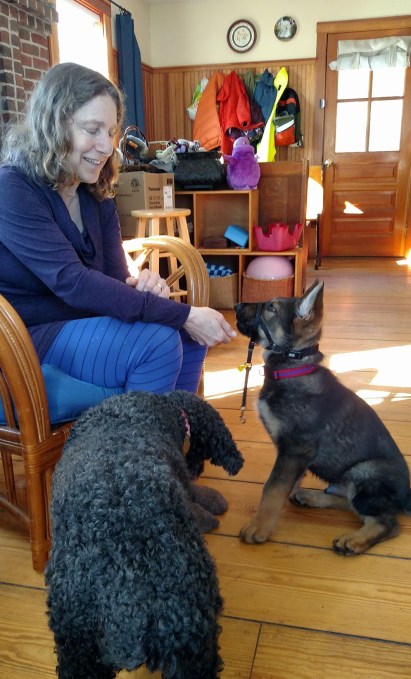
Mo'sheadhalter
Mo at 10.5 weeks

We control our dog’s environment in order to control available reinforcers. For many dogs, but not for tiny ones, a head halter gives you great control over a dog’s environment. Crates, gates, mats, doorways, fenced in yards, rooms in the house, hallway, in and out of the car: each one of these environments can be very carefully controlled to help condition a dog’s responses to distractions and exciting transitions.

But if we can’t control our own behavior, our dog’s behaviors won’t change.

So, that’s the challenge in animal training: we have to be fine with the idea that behavior modification is about us, too. I make mistakes every day, and everyone does! I open the door and the dog goes out. “Oops.” It really doesn’t destroy my training plan, it’s just our quirky imperfect style. Perfection isn’t perfect! If you don’t value mistakes as a natural part of the learning process — and powerful opportunities for growth – then maybe I’m not your teacher.

But if you want to create a plan to feel better and have more fun with your dog; if you aren’t afraid to use real “choice” (rather than force) to motivate your dog; if you expect dog training to be a lifelong activity that you do with your dog, and not just a temporary thing that you can do and it’s “done,” then  I would love to share what I know with you!
IMG_9033

Stay with us

Want to go on an affordable “get-away” weekend with your dog(s)? Come stay with us! You’ll have a dog friendly bedroom that opens into your own private entry and dog yard, with your own private bathroom.

You are welcome to stay and train independently (you must follow our humane protocol, no shock/prong/choke or abuse), or I can help you evaluate where you are and help you kick off a more effective training plan.

Our goal is to integrate physical fitness with behavioral fitness. So of course, we pick fresh food from the organic gardens! We sing around the campfire, run barefoot through the fields, and play in the snow! Come prepared to live a casual outdoor lifestyle. All animals behave best, when we feel best! Yes, we’ll show you how we observe behaviors, keep training charts and respect science, but if animal training isn’t fun, we change up the music! Our motto is “Dancing IS training!” We want you to have fun with your dogs.

We’re offering a special one week as we kick off this residential dog training program! $795 per couple or only $595 for a single person with one dog! Bring additional dog(s) $150 for the week.

Our dog friendly environment can give you a new perspective on how environmental cues build or harm your dog’s responsiveness. We are getting older now, and we’ve found it valuable to use our dogs to build our own fitness. We specialize in hosting barefoot field games (you might want to wear “barefoot” or very low structure sneakers that allow you to feel the ground. Ask us and we can recommend some brands). When you are here you can train to music, explore our gardens, or hike through the woods to the S. Freeport Village and Marina. The Portland Maine waterfront is 20 minute drive away. Bicycles and joggers are flying by here regularly. We’re happy to watch your dogs while you go out to play.

And you can go home with a training plan and new insights into your relationship with your dog(s).

Need a second room? A second bedroom room is available, comfortable for a couple, beside the bedroom and bathroom with your dogs.

Don’t have a week? If your booking is for 2018, family rate for both rooms for 2 nights/3 day weekend is $395 for your whole family, all your dogs. It includes up to four private dog training lessons. Go home with a better understanding of your dog and a plan to grow the behaviors you want to see. We can customize your experience. Tell us what you need.

We are LGBTQ and all kinds of other friendly! If you love behavior science, humane training, dogs, organic gardening, and blueberry pancakes, if you enjoy awkward scientist-organic gardener types, you’ll enjoy a learning vacation here in our home.

Control or cooperation

I like the idea of reinforcement based training, that’s how I see my approach, but part of reinforcement based training involves understanding the function of punishment, and noticing where it is, what it does. Maybe the best way to describe a training method grounded in behavior science is to observe how trainers control both reinforcement and punishment.

56F486B5-24A5-4AF4-B26B-70F3E28C8BEB
Understandably, it’s harder to observe behaviors shrinking and disappearing, than to notice and observe growing behaviors. Punishment is the function that shrinks behaviors. And most often, punishment is unintentionally shrinking behaviors the trainer WANTS.

Punishment can interfere with creativity, make an animal nervous, avoidant, less interested in the game. It can demotivate dogs. Very often, I notice people are “flattening out” their dog. They want him to behave so badly, they’re like back seat drivers, turning the dog into a passive puppet on strings. To achieve all that is possible with a dog, I think I need to encourage my dogs to think, not just “obey.” That means I have to let the dog make mistakes, have choices, learn from their own decisions, help me solve problems. Seeking “obedience” in dog training might lead towards more authoritarian body language and unintentional punishment, than training aimed more at enrichment, education, cooperation, and games of choice.

Trainers need to be aware of any punishment or reinforcement in the environment, and how it may be influencing our dog’s behaviors. Often, we need to condition our dogs to reduce the impacts of a sometimes punishing environment. That’s the core of communication. We control reinforcements and punishments to reduce suffering and strengthen cooperation.

Understanding behavior science is like understanding gravity, or even more, it’s like understanding chemistry. Understanding all the environmental elements of reinforcement and punishment, how they go together to impact behaviors, we can begin to recognize what shapes our own behaviors, not just our pet’s behaviors! This is one of the fun rewards of training with your dog!